Title: The Ayuuk space-time: Inscription and its (re)beginning[1]
Abstract: This essay reflects on the spatiotemporal conception of the Ayuuk People (Mixe People), taking as a starting point the problem posed by their inscription[2] and pairing with the Gregorian calendar. The text is divided into four parts: the first explains the notion of It-Naaxwiin (Totality/Universe); the second establishes the conflict with the calendars and explains the concept of Xëëw (Sun); on this basis, the general outlines of the freezing and displacement of the inscriptions are shown; finally, the proposal of the Ap Ok Xëëw (Sun of the Ancestors) is presented as a response to the conflict, grounded in its symbolic foundation and bound to It-Naaxwiin.
Keywords: epistemology, indigenous philosophy, Latin American philosophy, mixes peoples, ayuuk philosophy.
Space-time is defined in accordance with the society to which it belongs and the changes that society has undergone. In studying this matter in Ayuuk[3] culture, it must be made clear that what is in fact being analyzed is a conglomerate of peoples grouped under this designation, so that what is being reflected upon are the forms of encounter; for, despite the differences between the communities, there exist similarities that will help us address the issue of the various inscriptions.
The conception of space-time has a specific function within a society; it shapes modes of existence. In the face of a new episteme that takes root in the deepest conceptions, the Mixe peoples shift the direction of the construction of knowledge. This new form, in turn, redirects and intensifies the force of the struggle against the invaders. The difference in the cardinal points or in calendrical inscription, for instance, is not reduced to a cartographic change or to a change of the religious or civil yearbook, but rather to the disruption of the episteme. It also reveals the confrontations and the strategies of survival. Any point of inflection in a society has the potential to expand to different spheres beyond where it originated. Consequently, in modifying the functions in the manifestations of space-time, the modes of existence were modified as well.
In this work, a response is offered to the problem of the freezing of the inscription, to the problem of pairing the Mixe-Gregorian calendars, and to the symbolic groundwork for the changes in the new inscription: the epistemic transformation in the manner of relating to space-time. Language will be important for clarifying certain knowledges, since they are categories of analysis. While the variants of the language and the different ways of writing it may complicate observation, the concepts used here pose no greater difficulty, unless a clarification is required.
The spiral form
It-Naxwiin is the Universe. By Universe we must understand the space-time of Totality. Juan Carlos Reyes, a Mixe linguist and anthropologist from Naap’ookm (Alotepec), indicates that: “this space can be represented, to begin with, by three parallel horizontal lines within which are found two great spaces: tsajp ‘the sky’ and nääx ‘the earth’; between the middle line and the upper line, tsajp is delimited, and between the middle line and the lower line, nääx is delimited”[4] (2017, 17-18), following the parts of a body: head, entrails, and feet; or the figure of a tree: crown, trunk, and roots. Note also how one passes from the Universe to the space of the Earth: this is owing to the analogies that exist in ayuuk philosophy, linked by the very language (Nääxwiin–Nääx). It-Naaxwiin,[5] etymologically, is defined from “it”, a particle that alludes to space, place; while Naax-wiin is composed of two terms, naax (earth) and win (eye).
Guido Münch addresses the conceptualization of It-Naaxwiin in the following manner: “The universe is a differentiated and diversified unity; each of its parts concurs in a single end, the alliance of all that exists despite being separate”[6] (2003, 79). The idea of a differentiated and diversified unity allows a concept to be analyzed under distinct processes and according to the complexity that pertains to its expression. The word ayuuk is polysemic and transformative; it harbors a series of categories that condition cognitive forms. If the Universe expands, the human being is dislodged as the center of the Universe and becomes a peripheral being, part of something higher to which he must pay respect. The unity of the universe appears differentiated in the language of the ayuuk ja’ay (ayuuk persons); thus, “naaxwiin” becomes a differentiated word.
It-Naaxwiin is All; It-Naaxwiin is Principle; It-Naaxwiin is Cosmos; It-Naaxwiin is space-time; It-Naaxwiin is Nature; It-Naaxwiin is sacred language. It-Naaxwiin is Totality; it is the principle of all that exists,[7] it is center and point of reference, yet it could not be without a concrete position, such as is the universe.
It-Naaxwiin is also a symbolic space-time; it allows life in community to be organized, unfolding a series of magnitudes that encompass every stratum and corner of existence; it is not an imaginary resource, it is a representation of the concrete. Likewise, It-Naaxwiin encompasses the idea of physical territory and of territory beyond the demarcations, beyond the explicit frontiers of naming and the limits of a tract of land —a territory-land that encompasses the thinkable, a dilation or retraction over that which we may take in, in knowledge (intangible) as well as in what is perceived (tangible). It is also a zone-time that becomes four regions whose paths interlace to make known to us the designs, the forces, and the order of the universe.
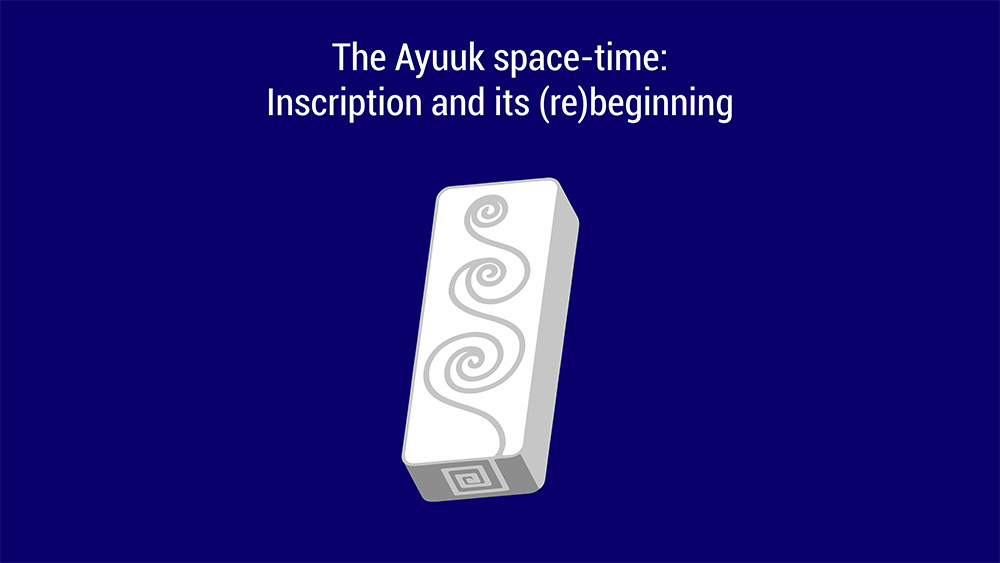
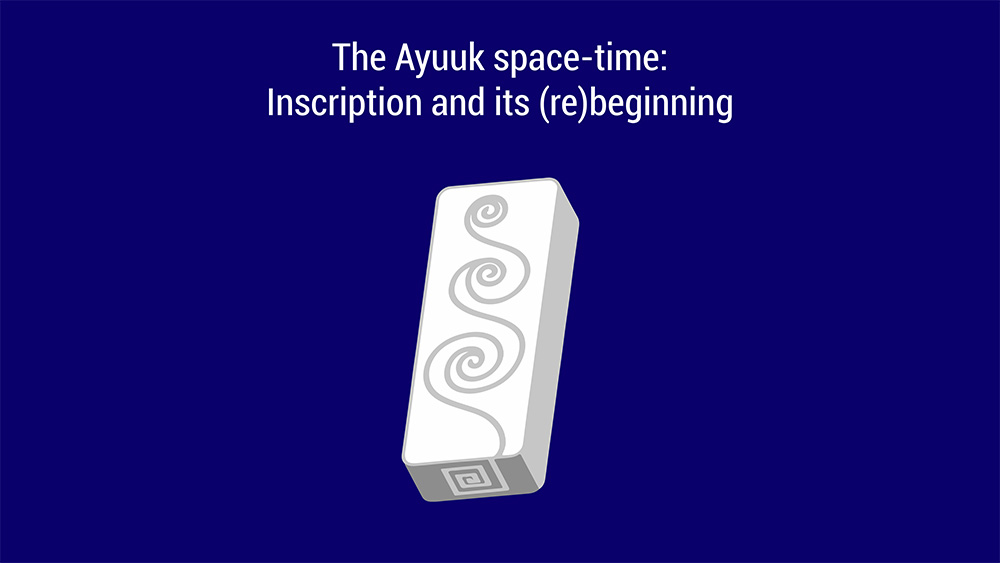
The ayuuk conception of space-time is a construction devoid of univocity, yet with clear references. The Universe is represented in the form of a spiral. The spiral has an unencompassable continuum, with no precise beginning or end.[8] The point of reference will always be shifting, even while central. The past-present-future will be disrupted, while the cardinal points will be turned so as to grant preponderance to the East. Religion, philosophy, and science—or what we may understand as three almost opposed types of knowledge—in ayuuk conceptions, will be able to dialogue without difficulty, owing to the need to establish constantly the bonds that sustain the people, like the reading made of the Universe.
The spiral turns counterclockwise, from above downward; each loop is a time-space of 52 years. This inscription was made in the calendars. Now, this spiral is also oriented in a three-dimensional dimension: above, in the middle, and below (the head, the entrails, and the feet); and a cardinal plane with the four regions, zones, or paths.[9] Reyes Gómez (2017) has shown the coincidence in different settlements. For her part, in Yásnaya Elena Aguilar Gil, a Mixe linguist from Tukyo’m (Ayutla), we can find how the language likewise reflects this notion:
The language we speak configures the manner in which we speak of time, in which we detail it. In the case of Mixe, time is also predicated in terms of space; only that this space is not horizontal, it is vertical —time traverses us from head to feet, time falls upon us: Ka’t y’aknajäw tii menp këtäkp, we say, ‘We do not know what comes-descends,’ or menp pajtp, ‘it comes, it rises’. (2015)[10]
The spiral form is the conception of the Universe, both astronomically and symbolically; a construction of scientific and social knowledge,[11] by which the plane of the cosmos and that of the people are established.
It is worth highlighting the work of Noemí Gómez Bravo, originally from Móctum, in compiling the oral history of her community, since in Móctum there lies what is perhaps the most ancient ceremonial center of the ayuuk ja’ay. The author mentions that: “On the stones that made up the ancient ceremonial center of Móctum, the symbol of three rivers is found —three spirals that form a single river” (2004, 52-53)[12]. In the symbol of the three rivers, whose cycles flow from left to right, one may discern another symbol of time.
Each path of the four regions is paired with a color and with a sense of the measure of time.[13] Reyes indicates that —in correspondence with the rotation of the Earth, the measurement of the day-night cycle (ja xëëw-ja tsuu), and the movement of the spiral— the rising of the sun (xëëpëtsemy) belongs to the East; that is, to birth (mi’inën-jäjtën) and to the color red (tsapts); as for midday (Kijkyxyëëw), its elements are the North (Pakypyojtu’u), the color white (poop), the good (oy), and light (Aajäjk); sunset (xëëtsi’ity) corresponds to the West (Xëëtsi’ity), to black (yëk) or purple (tsu’unk), to darkness (aakoots), and to the not-good (ko’oy); in the case of midnight (tsu’p), its equivalent is the South, yellow (pu’ts), and death (o’kën-tëko’oyën) (2017, 20-27).
The principle or birth of the day, like that of life, takes place in the East; the end of its cycle is nested in the West, making way for the cycle of night and death. Two differentiated cycles, of time and of life: midday (Kujkyxyëëw) and midnight (tsup). The existence of the human being, the Earth, and the Universe stands in accord with this movement: life and death. The cycle repeats itself in a continuous rhythm. The succession and alternation are modifiable.
Thus, death is also the beginning of a new journey. Death is life. The deceased continue in another space-time (in the dimension of the dead), and, being another path, it must run contrary to the direction of the spiral of life:
[…] the beginning of this inverse journey of the souls is the beginning of the journey from Tuk it, this world, to Ja tuk it, the other world. This journey follows the line of the spiral (now to the right, in the direction followed by the hands of the clock) until it returns to the point from which it departed, which is precisely the point where the four great paths that cross the universe intersect. (Reyes 2017, 28)[14]
The dead are tied to the living. Dialogue is a constant in these societies, in which it is not necessary, of course, to wait for the Day of the Dead in order to make offerings to them. It is important to reflect on the symbolism that the dead represent, since this will allow us to establish their link with the postcolonial inscription. The spatiotemporal representation unfolds categories; for this reason, the construction of a model of the cosmos resulted in an epistemological pattern. The series of patterns that repeated themselves constantly at intervals followed one another in daily life.
The Cosmos is organized in the form of a spiral; thus life follows its inertia[15]. The model of thought also succeeds itself and alternates by virtue of the different intensities and durations of life; yet, although there exists a pattern of succession, it may be altered. Hence the need for a (wise) person who knows how to read the Universe (in the astronomical plane, in the signs of Nature, in the relations between peoples and persons). The sages who devoted themselves to deep reflection upon the Universe stood in constant observation-interpretation; from this it follows that, in the successive ways of registering events, the necessary changes were made in the so-called “calendars.” Araceli Rojas points out that
These arbitrary systems organize and represent time, but are not necessarily in accordance with nature (James & Mills 2005: 13). Cultures since ancient times and around the world have developed ways to adjust their calendars to astronomical time (e.g., leap years). Since calendars are human constructions which divide the natural flow of time, they are also full of cultural significance. (2013, 220)
Calendars are arbitrary systems for the Universe, but patterns for human beings. The spiral, then, already provides us with a form for comprehending the succession and alternation of human movements, of the throbbings in the intervals of time, of the spatial distances, and therefore of the dilation or contraction in the perception of events.
The Path of the Sun
The function of the calendars was very broad: it governed civil, agricultural-laboral, and religious-symbolic modes of existence, the destiny of persons; yet it also required constant attention, since the Universe/Nature/World displayed itself as changing. There existed a double bond between the language of the Universe and the reading of the sages.
In the Mesoamerican calendars certain similarities may be discerned; in general two types have been distinguished: the cycle of 365 days (18 months of 20 days each, which would yield 360 days, plus five ill-omened days, for a total of 365) corresponding to the agrarian period, and a sacred or “divinatory” cycle of 260 days (20 signs and 13 numerals, which multiplied give 260 days). The combination of the two would form a cycle of 52 years.[16] After the persecution of “Indian matters” by the Spaniards, the practice and the inscription —in some peoples— gradually faded, and the measure of time was changing, becoming separated from the spatial conception.
The Ayuuk calendar is defined by the ritual calendar of 13 numerals —that is, the numbering from 1 to 13— combined with the 20 days or signs (each sign had its name). The agrarian calendar is composed of 18 months (each of which has its own name), combined with the 20 days or suns. As may be noted, both calendars —which are in reality part of a single articulated cycle— are connected by the 20 suns; that is, by the path of the sun (xëë tuu). The names of the months as well as of the days are not the same in the ayuuk settlements; in each settlement there are variations, whether in the name of some day or month, or in the starting sign. There is an extraordinary period that would not properly be a month, since it does not belong to the 18 months of the agricultural cycle and has only 5 or 13 days (depending on the theory that sustains it), which comprises the unattached days for the beginning of a new cycle. The agrarian calendar is the one that has given rise to the greatest conflicts (owing to the variations of the unattached days and the counting of the leap years), while the ritual calendar is the one that has served as the basis for attempts to pair the Mixe and Gregorian calendars.
A constant in history has been the search for the comprehension of the calendars and the manner of pairing them with the Gregorian count. Even with so many studies on the best-known of them —the Maya and the Mexica— discrepancies persist (and it must be considered that other calendars have existed which have not been studied in depth). Practically each people had its own measurement, so that the pretension of synchronizing them all would be a titanic labor.
Another of the conflicts that calendrical pairing has posed has been the problem of leap years; thus it has been indicated that at the end of the long count there would be 13 days of suspension before initiating another cycle, which would give rise to the idea of a third, civil calendar that would not vary. With this also looms the conflict concerning the freezing in the count of days. Perhaps the study by Alfonso Caso, in Los calendarios prehispánicos,[17] is in recent years the most influential proposal for pairing the different reckonings.
Torres (2011) conducts his study on the annual Ayuuk calendar (365 days), whose purpose is to relate it, month by month, to the Mexica and Maya calendars; his study is based on four Mixe versions, three from Mazatlán and one from Guichicovi. He first pairs these and then compares them with the Tenochca and the Maya. In order to synchronize them, he resorts to the double months.
Aligning three out-of-phase calendars from three cultural blocs presents several problems: first, it presupposes that they share the same measures; second, that there was simultaneity; third, that on the arrival of the Spaniards the displacement displayed the same symptoms; fourth, that their historical processes yielded the same results; fifth, their dismemberment, when the cycles ought to be viewed in articulated form.
It is possible to find a greater proximity between the Maya and the Ayuuk calendars,[18] certain lines of encounter; yet between them we shall also find a great distance, owing to their historical processes.[19] Let us consider the territoriality and the conditions prior to the Spanish invasion: both cultural blocs had territories-frontiers that intermingled; certain societies served as mediators —societies that today are regarded as part of the Mayan and Mixe-Zoque linguistic families.[20] Proximity allowed for certain exchanges. By contrast, there was greater animosity toward the Mexicas (and their Nahua, Zapotec, and Mixtec allies). The Ayuuk waged fierce battles to avoid submission and to free themselves from tribute. On the other hand, after the foreign irruption, the Mayas maintained their count, making it match with the calendar of the Spaniards; the Tenochcas could not, since their calendar was confiscated; the Mixes, for their part, hid theirs.
Reyes mentions that there is a greater proximity between the Mixe settlements of Alotepec and Totontepec (Oaxaca), as well as with the Zoque of Rayón (Chiapas): “although the ritual forms of the numerals of the ayuuk calendar appear to bear greater resemblance to the Mixe of Totontepec and to the Zoque of Rayón than to the Mixe of Alotepec” (2017, 43).[21] To understand this, one must grasp the ancient territorializations, the displacements of the peoples (during the various reducciones), and the external categorizations made by the specialists who “mark” differences and “establish” similarities —owing to their epistemological framework.
In order to understand the reckoning of the cycles, it is necessary to attend to two essential figures: the Sun (Xëëw) and the Moon (Po’o). The celestial bodies are spatiotemporal categories that complement one another, commonly explained within the “myths”; they are, however, metaphors of space-time and concrete physical markers that appear in oral histories. They are part of astronomical knowledge, guides of labor and of the destiny of the people; on the other hand, they continue to govern the categories of time —modified, not emptied— which redirect the forms of life.
For his part, Floriberto Díaz, a teacher and anthropologist from Xaamkëjxp (Tlahuitoltepec), indicates: “in many indigenous peoples the origin of the people is related to the Sun and the Moon, which are the celestial bodies that determine the time of life of the beings who populate the surface […]” (Robles and Cardoso 2007, 51).[22] Díaz, moreover, places emphasis on the relational form of the modes of life on the basis of the celestial bodies, for the observation of Nature and the Universe.
There exists a great quantity of teaching narratives,[23] with their corresponding variants, on the origins of the Sun and the Moon. What I wish to highlight is a central idea: the Moon pursuing the Sun, for it is here that the metaphors come into view. First, that, being siblings, they have an analogous relation; second, that they are complementary (day-night; man-woman); and third, the positioning, since it displays the consecutive mode (the counting from ja xëew to ja tsuu to close the duality).
The Sun is the guiding celestial body; therefore, its place of birth would be the East, whence the day begins to be counted; astronomically, it would also occupy the primordial place in the creation of our galaxy. Then the Moon is the younger sister who follows the elder body, always unreachable, since she is destined never to stray from the house (Earth).
In order to comprehend the Path of the Sun (Xëëw Tuu) or solar calendar, it is necessary to understand the concept of “Sun” (Xëëw). Federico Villanueva Damián, a teacher and poet from Tukyo’m (Ayutla), expresses it as follows:
Xëë, ku tu’uk xëë’ety njuujky’äjtyë’n najknäjxyë’n.
Xëë, ku nmëmyujkyë’n jëts na’amuk .
Xëë, ku nteety’äjtë’m xkuno’ojkyë’n jëts jo’kx’äjtë’n xmo’oyë’n nayjë’n.
Xëë, ku tu’uk atom nkë’m xëë nmëët’äjtyë’m. (Villanueva 2018, 105)[24]
Xëëw, or Xëë, will refer not only to the sun; it has further significations: day, name, festival, and sun. The Sun as temporal measure refers to the bright day, a cycle from the birth to the death of the sun. Xëëw understood as festival or celebration takes radiance as its metaphor; hence the great or major festival of a people is known as Mëj Xëëw (Great Sun); likewise, the days of the dead are termed Ap Xëëw (Sun of the Grandfathers) or Ap Ok Xëëw (Sun of the Ancestors), and it is the greatest celebration of the Ayuuk peoples. Of course, this latter cannot be detached from the idea of birth (new cycle); whence we also relate it to “name” and so the question is asked: ti mxëëw —that is, what is your name, or what is your sun or destiny? The ritual calendar is the one that defines the name/destiny/sun of the newborn. When a boy or girl is born, his or her fortune must be read (the name, in former times, was determined by this destiny); this was not detached from the life of the forebears. The reading of the maize for knowing the fortune of the newborn is also bound up with the four paths. Thus Xëëw stands in correlation with the directions of the cosmos, the colors, the winds, and the dates associated with the agriculture of maize.
The image of the path of the sun should not lightly be dismissed. It is a figure whose operative capacity highlights the two entities (space and time) on a single plane through walking. The sun walks signifies the time that passes and the space in which it does so (the path). The path of the Sun is the image between a subjective act (movement) and the territory: the times bound up with the territories we inhabit, which we walk; space, distance, is what is reckoned in movement. A double image: the Sun (xëëw) that walks in the Universe (Naaxwiin); the human being (ja’ay) who walks the Earth (Naax). The Sun maintains an operative attitude at different levels of life; therefore, the calendar follows these steps. A measure has as its end a precise limit, but a wave is a magnitude in expansion.
Now, the Moon also serves as a marker of the measure of time (and of space). In ancient times the month consisted of 20 days or suns. “Month” in Ayuuk is said Po’o (moon). Tajëëw Díaz Robles, originally from Xaamkëjxp (Tlahuitoltepec), indicates: “The Mixe numbering system, like that of many Mesoamerican cultures, is vigesimal. It is for this reason that in rituals and offerings it is a number to which recourse is made. Twenty is a cycle, a complete count” (2015).[25] In some settlements, such as Santiago Zacatepec, the count of the moon is still used in mentioning the months a baby is. It should also be noted that in Zacatepec[26] the month is counted in reference to the moon, so that the way of pairing January is with tu’uk po’o (one moon, or first month); and of course, it would no longer be twenty but thirty in order to accommodate the Gregorian calendar. The calendar (or the two calendars, the annual and the sacred) is read by the xëëmaapyë (reader of the sun). In the inscription of space-time the reader or specialist is important.[27]
Returning now to the conflict in pairing the calendars, several points must be considered: first, the attempt to pair the agricultural calendar with the sacred; then to make them coincide across different cultures. Torres (2011), to this end, relies on the proposal of the double months, following the idea that the sacred calendar is the one that was preserved almost intact among the Ayuuk.
Torres, in affirming that the annual Mixe calendar preserves the ancient structure, asks about the content that may have been preserved; thus he begins by comparing the Maya, Mexica, and Mixe calendars, reviews the names, and pauses on those that are double months: “it is to be noted that, besides the Mixe, nearly all Mesoamerican calendars feature ‘small’ and ‘large’ months that form pairs; it is this form of the months that I call ‘the structure of the double months’” (2011: 183).[28] The proposal of the double months is not new; it has helped to understand the behavior of the reckoning and the forms of ordering the months of the different calendars (Nahua, Otomi, Tarascan, Chiapanec, Maya, and Mixe).[29]
Torres remarks on the prefixes “great” and “greater”, which are present in the Nahua and Maya calendars, and which correspond in Mixe to mëj (great) and jak (greater); with this he aims to pair the three calendars (Mexica, Maya, and Mixe). After certain attempts, he largely accomplishes his aim; one of the elements that gives him certain doubts is Mëj Kaj Puut and Jak Kaj Put, which he translates as “Great Town” and “Humidity”, respectively, making “Humidity” correspond to the rainy season and equating this circumstance with the other reckonings. In any case, it is in this example that the importance of language may be discerned, since, given the way it is structured, it ought rather to be “great town” and “greater town.” It must be remembered that Mixe can give rise to a conflict if it is written by phonetic association. For the moment, let us retain these names in order to understand the problem of pairing and of the misalignment owing to the Spanish invasion.
In the conflict of pairing the calendars the question is the misalignment, but also the epistemic senses. The freezing and drift of the calendars require closer attention, going beyond the mere pairing of dates —without denying its importance— and including consideration of the change from the Julian to the Gregorian calendar in 1582, with the loss of 10 days in the Western world. The effects brought by the forms of a new model of life disrupted the very system of inscription.
The freezing of the inscription
Each calendar showed its beginning in a different season or sign; as Caso notes,[30] the populations began it in different months, which includes the various Mixe peoples.[31] The considerable differences in the changes of inscription among the peoples are due to their particular processes. To establish a synchrony across different peoples already entails a series of difficulties that speaks only of those who try to match them, in a unifying tendency—an epistemology of unity. Synchrony is an illusion.
The beginning of the calendar, after the European invasion, has been one of the central concerns in its study: to establish a transversal line from the past toward the present, without taking into account other factors that sustain such processes —hence, the freezing and drift become motives for reflection. “Beginning” may also signify a new path or cycle, and this makes a great deal of sense in the epistemology of the indigenous peoples. Yet one might ask whether we are, in fact, speaking of a re-beginning. This would be a situated point, not a dated point. The situated point would stand in relation to the space-time that unites the symbolic with the physical
In Akostë Xëëw (The Feast of August) Torres (2017) addresses the problem of freezing and displacement; once he has set out from his adjustment by the double months in the annual calendar, he finds that, although it can be paired with the Gregorian calendar, it presents another conflict: how, or from which month or sign, to establish the equivalence.
Torres (2017) seeks to establish equivalent dates for ancient festivals preserved in the liturgical calendar; thus, for example, he reviews the date of the Feast of the Assumption, celebrated on August 15, locating it especially in Santa María Alotepec without ruling out other communities such as Tepantlali, Tlahuitoltepec, and Ayutla. From the foregoing, the slippage of the calendar, for Torres, falls in the month of the “carnival” or festival. But, were this so, the Akostë Xëëw[32] would be present in all the communities, which is not the case, since the peoples lack unification for the Great Festival (Mëj Xëëw); this speaks to the autonomy of each community and even of an epistemological variant in the perception of space-time.
With respect to the drift, Torres indicates: “in an investigation on the Mixe rites and calendars [Torres 2001] I arrived at the conclusion that the Ayuuk calendar of the twenty-day months was displaced with respect to the solar year and the agricultural cycles; although on this there is no agreement, and what is worse, the debate seems to have lost interest among the specialists” (2017, 426).[33] Worth emphasizing is the disjunction the author presents between the calendar of the twenty-day months and the solar year, which would speak to us of the internal displacement in the ayuuk inscription. In the case of Reyes we can find certain coincidences with Torres’s proposal, following Alfonso Caso:[34]
On Caso’s comment, we should add that, effectively, on the basis of the results of our research, the xëëmaapyë, ayuuk priests and priestesses who keep the count of the days, counted the years 1700, 1800, and 1900 as if they had been leap years, just as, no doubt, they will count the years 2100, 2200, and 2300, which will likewise not be considered leap years in the Gregorian calendar. On this point we must clarify that the count of 260 days runs constantly and uninterruptedly, in such a way that one count has scarcely ended when another immediately begins, taking care only to add one more day (February 29) every four years, regularly. (2017, 86)[35]
It is possible that both authors (Torres and Reyes), in following Caso for the pairing of the count of the days, are supposing that there is no error of calculation.[36] The ritual calendar therefore turns out to be infallible for the purpose —the most logical thing, since it allows the cycles of time to be articulated— but it is not merely a matter of the synchrony of two forms of inscription; rather, the very “alteration” is a symptom of the change that the Spanish invasion must have provoked and, therefore, of the reinterpretation of the world.
Alfonso Caso establishes the relation derived from the 52-year cycle, the four year-bearers or names of the annual days, placing the four zones in relief; but the turn in the change of the Path of the Sun is too important an image to let pass, if we consider the different links that unfold from Xëëw. It is also important to show that, in the establishment of the Gregorian calendar, in 1582, the suppression of the ten days fell in the month of October (from the 5th to the 14th), so that October 4 was followed by the 15th of the same month. If we think that Caso made the pairing with the Gregorian calendar, the historical documents dated in their moment are not precise.[37]
Reyes, following Caso, mentions that the freezing takes place in relation to the Gregorian calendar:
From the time the first descriptions of the ayuuk calendar were made, between the late 1950s and the early 1960s, the date of its beginning and ending was already ‘frozen’ upon the Christian calendar (Caso, 1963: 72). At that time it was said that the solar year began, invariably, on the first day of what is now the month of November, and ended with the count of the days mutsk tsatsok (or nemontemi), the last day of the month of October, in order to begin a new year again the following day, November 1, and so on. (2017, 91)[38]
He mentions further that in San Juan Mazatlán the calendar has been preserved to the present, and that, for no apparent reason, the beginning of the year shifted to October 15 or 16. Let us retain the beginning of the count in November, which will turn out to be significant, as well as the displacement, since these are points of inflection.
The matter of the freezing and displacement of the inscription of space-time and, in consequence, of the perception that led to the modification of the deepest conceptions, must be examined alongside deterritorialization and the sociopolitical losses. Examining the reterritorializations in the different peoples helps to unravel the disparate forms that exist within the Ayuuk peoples. This offers us an enlarged cartography of the zone, of the movements that were generated. There were two great displacements (during the Viceroyalty and in the nineteenth century with the formation of the national political divisions) and other intermediate ones.
Torres intuits that, in the displacement of the calendar, the peoples’ own elections were at work, in contrast to what would be supposed an imposition by the viceregal authorities: “my opinion is that the Mixes were obliged to make the adjustment or to manipulate the calendar on account of the influence of the Catholic calendar and when the harmony and the coincidences were lost” (2011, 194).[39] The Mayas did likewise in order to bring the dates of the Spanish calendar into accord with their own; they too resorted to freezing. The Mixes, for their part, had two different types of advance by the Spaniards: from the side of what is today Veracruz and from the Isthmus (Oaxaca), after the contact with Nahua and Mayan societies —which means that the Mixes had time to decide how to proceed, among other things, to hide their knowledges. Although the inquiries into “Indian things” continued throughout the Viceroyalty, we see how in the 18th and 19th centuries various books continued to be found in the hands of indigenous people.
But is it really necessary to display the equivalences, knowing that dates are arbitrary points in the temporal measurements of the Universe? What meaning does 1523 or 1524 have in the last station of the Xëëw Tuu, if we do not pair the dates with the Spanish incursion into the first Mixe peoples?
What does the freezing, displacement, and (re)beginning of the count of the inscription suppose? What might be the beginning of the new path? The problem is centered on the turn in the temporal measure, for one should consider the alteration in the Path of the Sun (Xëëw Tuu), that is, the displacement of the Sun in beginning “the day” —no longer toward the left, but toward the right. The clash between the two turns (the Mixe, which begins from the left, and the Mexican, which begins from the right), according to the count of the calendars, must produce a displacement in the dates, above all by reason of the conflict that the leap years entail (Reyes 2017). Reyes explains what the impositions of the new calendar provoked among the ayuuk: “All of the foregoing also entailed the renunciation of the system of time-adjustment that the xëëmaapyë or kooxëëw ayuuk used previously, which began each year a quarter of a day later, at four different moments of the day, which allowed them to adjust the vague or calendrical year (which lasts only 365 days) with the astronomical or tropical solar year (whose duration is 365 days plus a quarter of a day)” (2017, 92).[40]
The idea of freezing or displacement among the specialists on the ancient Mesoamerican calendars is recurrent; however, for the Ayuuk case it would be necessary to discern between a space-time of freezing and displacement totally planned and considered in accordance with the astronomical movements that would have implications in the life of nature as in human life. The change in the inscription of the Path of the Sun, or Xëëw Tuu, is a first symptom of the transformation in the perception of space-time. Here is the displacement that bears upon the perception of space-time, and therefore of the territory and the movement of the people.
In the case of a suspension or freezing of the inscription of space-time in order to accommodate the path of the sun, such a suspended space-time would still count —that is to say, it would have to be measured under dynamics that would permit the calendrical reckoning to be carried forward. Hence, when one attempts to pair the ancient inscriptions and give them continuity, the macro events (universal) and micro events (human) escape the logics, when looked at in the light of an epistemology that ignores or lacks the knowledges of the communities.
Two images must be knotted together: the cycle of life and death, and the cycle of day and night, with their symbolisms. The enemies came along the path of the Sun, and with that began the time of darkness. Thus, by freezing we must understand the conscious act of prolonging the inscription of the time of darkness, the epoch of misfortunes —as a form of resistance for guarding one’s own knowledges and comprehending the new time-space that the foreigners bring.
Even when a beginning might be established for the pairing of the Gregorian dates with the ayuuk calendar, the sense would not be comparable: it is not the same thing, November 1 and the Ap Ok Xëëw, even though both refer to the day or festival of the dead. The senses are dissimilar; therefore, the Gregorian date and the ayuuk time do not necessarily have to coincide.
Ap Ok Xëëw: The (re)beginning of the inscription
What should be the importance of wanting to pair the calendars, if a date is a blind point in the numerals, whereas the event is what gives sense to a determinate time? Beyond the purpose of pairing the dates of two dissimilar calendars, what does the displacement say to us? The disruption took place during the settlement and the first years of the Viceroyalty. The change that the new order entailed brought with it a series of measures that altered life. The change in the forms of inscription bears upon the inscription itself. The new system brought the persecution of the ancient forms, so that the strategies for survival were very varied. As the production of inscriptional materials diminished, a great part of the knowledges was kept within orality, and others were hidden.
For Torres, the form by which the ancient count survived was: “the ‘freezing’, as happened with other calendars during the Colony” (2011, 191).[41] The suspension of the inscription involves a social, political, religious, and bellicose situation, on account of which the sages must have maintained caution; the freezing should be, in any case, a calculated act for restructuring the different bonds and understanding the new ones. Nevertheless, Torres adds: “but this hypothesis is not sustained, since the months, instead of advancing, fall behind” (2011, 191).[42]
Juan Carlos Reyes had considered that this displacement was due to the change in the conception of the calendrical inscription. It is possible, too, that the change in the turn of the direction of time is acting as a kind of freezer to show the beginning of another cycle. Now, the Ayuuk calendar should not have fallen out of adjustment beginning in 1519, but in the years 1524-1525, which were the first incursions into the territory on the part of the Spaniards; and to a greater extent it would have had to be at the end of the sixteenth century, when the defeats began.
In the various calendars of Mixe authors and anthropologists there is coincidence on the name of the first month mëj kajpuut, mëj kajpu’ut, or mëj kajp uut,[43] so this ought to be a sign for understanding why the freezing and displacement would have taken place, whether in this period or shortly before. The point is not to reduce the matter to the mathematical forms of the dates, but to attend to the other bonds. If the astronomical observations, like the social organization of the community, are seen to be altered, the mathematical alterations would have to be an effect and, perhaps, not only a cause.
Thus, Torres pronounces: “put another way, the only possible explanation is that the Mixes made the beginning of their year coincide with the feast of All Saints. The foregoing probably owing to its proximity to the Christian feast of the dead […]. The basis of this comparison is the system of ‘double’ feasts” (2011, 191).[44] The coincidence between Ap Ok Xëëw and the Day of the Dead must have a more profound purpose than the proximity of the feasts. Let us recall that, for Torres, the correlation of the dates in the different calendars is made by way of the double months and following the signs of the Mexica calendar; but if we separate it from this society in order to search further within the ayuuk symbols, we may probably find other motives.
Torres (2011) nevertheless places in relief the importance of the mëj kajpuut and of “the Mixe feast of the dead”, two points that are knotted together. What proves significant in the matter of the freezing and displacement is that, in light of the documents gathered from the time of the Viceroyalty and that one tries to reconcile with the current reckonings, both Mixe and Hispanic, there is a constant indication that the count does not match: “in the sixteenth century the Mixe months continue to fall out of adjustment. At a given moment, the Mixe manipulate the calendar. There are certain proofs, since the calendar is fixed to the year at present, and there are two different beginnings of year, October 15 and November 1” (Torres 2011, 192).[45]
Then there was not just one attempt at freezing producing the displacement, but several emplacements —which calls one’s attention— since, why would the ayuuk ja’ay have the obsession of making the beginning of their calendar, specifically the Ap Xëëw, fit with the feast of the dead, if not because they too had resignified the Christian period of the dead as the beginning of the calendar of the enemies?
Torres (2011) expounds that there are several explanations for the freezing, displacement, and readjustment of the Mixe calendar with respect to the Christian calendar, but that only two are feasible; the first has to do with the intentionality of the indigenous themselves —also that, faced with the change from the Julian calendar to the Gregorian, the Mixes again voluntarily emplaced their inscription (Torres 2011), thus returning to the matter of the coincidence of the beginning of the ayuuk calendar with the Christian feast of the dead.
The date of the dislocations is notable, 1582, since it shows that the Christian calendar too was frozen and displaced; in addition, by the decade of 1580 the first ecclesiastical constructions in Ayuuk territory begin. As to the second possibility, Torres (2011) marks this date as the one at which the Mixes shifted their calendar to the Gregorian.
What we must emphasize is that the Mixes, in their own process, decide on the manner in which their calendar should walk; or, better said, under their reading of the world, of nature, and of the universe, the calendars had to coincide on account of circumstances different from those of the Spaniards.
Torres pauses on the leap years and notes the coincidence produced by the constant modifications: “another possibility is that October 15 be the date of the 15 leap years that took place between 1519 and 1582 (63 years/4 = 15). It would be an enormous coincidence, since the Gregorian calendar ‘begins’ on October 15. But the indigenous did not understand any of these changes and fixed the calendar to this date…” (2011, 192-193).[46] The matter is not whether or not the ayuuk ja’ay had understood the adjustment in the new Gregorian calendar —above all because they had the astronomical and mathematical knowledges needed to understand the matter— but rather that the intention of establishing the mëj kajpuut and the Ap Ok Xëëw with the festivity of the Christian dead seemed to be more important. The key to understanding the displacement is found in these two temporal stations, whose dimension is related to the sacred and social spatiality.
We know that the ayuuk calendar begins in the month mëj kajpu’ut. Both Torres (2011) and Reyes (2017) follow the marker of Lipp. Torres follows the idea bound up “with the first villages or hamlets of the Mixes that marked the route of the pilgrimage” (Torres 2011, 189);[47] while Reyes —besides considering the foregoing— adds:
Mëj means ‘great,’ and Kajpu’ut is, apparently, the name of a region that at some point was strongly devastated by a great earthquake. In this regard, Mr. Montero wrote: “November 1st; in ancient times there was a very great tremor and it broke the towns of Mejcajpud” (Weitlaner and Weitlaner, 1963: 52). Mëj Kajpu’ut, then, may signify “Great Ancient Town” (2017, 73).[48]
Here are the signs to which we must attend. The pilgrimage or migration is the topos par excellence for indicating the history that begins, the origin of a people, the path/cycle that begins.[49] There are three images that are knotted together and offer us the traces for disentangling the matter of the “beginning” or “new cycle” of the inscription of space-time.
The Great Ancient Town shaken by the earthquake is a recurrent image in Mixe accounts: it is told that the earth opened, that the earth spoke; when such an act took place, many persons were swallowed by the earth. The region is a zone of seismicity. The other figure is that of the dead. In Ayuuk culture the dead are entities that interact with the living; they too can decide upon life. The dead is one of the greatest festivals of the region. The Ap Ok Xëëw, Sun of the Ancestors, is a period in which the dead return to the home, a period of suspension, before returning to the cycle-earth of death. The third allegory is that of migration, which in any case is bound up with the two preceding: the path/the time. The Great Town is the point of intersection between two cycles, that of death and that of life. The destroyed Great Town generates the walking of a new path for the living, and the cycle of darkness for the dead, who likewise must begin their own walking.
The Ap Xëëw of the month mëj kajp pu’ut is the period that must matter to us, which may correspond to the end of October or to November 1; this passes to a second plane, since the Ap Ok Xëëw encompasses several suns. It is the period of an other-time that must be highlighted. This is the time-space that was configured after the arrival of the Spaniards, for a new count, in order to articulate a sense that would be in accord with the changes produced at the social and astronomical levels. The period of freezing must have taken place prior to the Ap Xëëw; the displacement would be the consequence of the lapse.
The time of death is prolonged; but, unlike among the Maya, it begins earlier and extends further. The first expeditions against the Mixes are in 1523-1524, with their period of greatest intensity between 1570-1580, though for the seventeenth century the Mixes of the interior of the mountains continue without surrendering. The first displacements begin in what is today the Isthmus and the zone of Veracruz.[50] This latter is of interest, for the forced displacement becomes a new type of migration. The villages are destroyed, the dead remain behind (the old or great villages), and the living must continue their path. Some found new villages; some families whose villages are destroyed integrate themselves into the existing settlements, among other situations.
Let us recall the words of Reyes when explaining the cycles of life and death. The cycle of Tuk it follows the inertia of the universe, toward the left; while Ja tuk it goes toward the right. If this is so, the image would have to be very powerful, similar to that of the Mayas, who, on emerging from the period of freezing under the Spaniards, regard themselves as in a period of darkness and misfortunes; whence, in their new cycle, it is indicated that it will be the rebirth of the Mayan people. The change in the direction of the turn of the spiral draws the idea of the zone of death. To return the trajectory, the inscription must be frozen, a suspension that would permit life to be rearranged.
The freezing must have brought the period of misfortunes, the darkness, the concealment of the Sun (Xëëw); for this reason, its path was altered. The period of dislocation was prolonged into an allegory of the dark region; what could set the new calendar walking is the entry into the land of the dead.
It-Naxwiin expresses itself in the dead, and it is inevitable to think of the displacement of the Ayuuk. The displacement becomes potentiality. The freezing and displacement have remained behind, in the time of the emplacements; nevertheless, the displacements (territorial, calendrical, of existence) have produced modes of struggle and transformation. What is to be emphasized, both in the modern order of the ayuuk calendar and in the one adjusted during the Viceroyalty, is the constancy of Ap Xëëw. The life of It-Naxwiin, of the persons, of the people, of the earth, are bound together. Floriberto Díaz expresses it: “for what is death for some is the germ of life for the new generations; and for that reason we make the feast of the grandparents each year, awaiting the cyclical return of our old fathers-mothers” (Robles and Cardoso, 2007, 53).[51]
The dead are a substantial part of life. Death gives way to life. The Sun, upon ending its path, dies; it remains in an epoch of darkness; but upon ending the path of the Moon, of the night, it returns to be born again. The cycle —let us remember— is uninterrupted. To consider the freezing on account of the dead proves possible; the alteration of the inscription a necessary decision for the synchronization of the Earth (Najx) and the Universe (Najxwiin); and the displacement, part of the representation of the physical movement. For this reason, it is in the Ap Xëëw, in the first month mëj kajp pu’ut, that the ayuuk inscription of space-time (re)begins.
References
Aguilar, Yásnaya. 2015. ¿La diversidad lingüística tiene un gran futuro por delante?: Tiempo, espacio y metáforas. Este País, 24 de julio de 2015. http://www.estepais.com/articulo.php?id=101&t=la-diversidad-lingistica-tiene-un-gran-futuro-por-delante
Audi, Robert (ed.). 1999. The Cambridge dictionary of philosophy [second edition]. Cambridge: Cambridge University.
Barros van Hövell tot Westerflier, Alonso. 2007. Cien años de guerras mixes: Territorialidades prehispánicas, expansión burocrática y zapotequización en el Istmo de Tehuantepec durante el siglo XVI. Historia Mexicana 57 (2), 325-403.
Bartolomé, Miguel Alberto. 2004. Una aproximación al pasado. In Los pueblos indígenas de Oaxaca. Atlas etnográfico, Alicia Mabel Barabas, Miguel Alberto Bartolomé, and Benjamín Maldonado (Eds.), 117-123. Mexico: INAH – FCE.
Bernal Romero, Guillermo. 2012. La cuenta larga y la máquina del tiempo. Arqueología mexicana 118 (Nov.–Dec.): 30-37.
Caso, Alfonso. 1967. Los calendarios prehispánicos. Mexico: UNAM.
Castellanos, Javier. 2014. Dxiokze xha… bene walhall / Gente del mismo corazón. Mexico: Conaculta.
De la Cruz, Víctor. 1995. Los nombres de los días en el calendario zapoteco Piye en comparación con el calendario nahua. Estudios de cultura Náhuatl 25: 149-176.
Deleuze, Gilles. 1986. Nietzsche and Philosophy. Tranlated by Hugh Tomlinson. New York: Continuum.
Díaz Robles, Tajëëw. 2015. EE’PX: Nuevas lecturas de Floriberto Díaz Gómez (1951-1995) desde el siglo XXI. Supplement Ojarasca of La Jornada, September 12. https://www.jornada.com.mx/2015/09/12/oja-robles.html
Eliade, Mircea. 1954. The Myth of the Eternal Return. NY: Bollingen Foundation.
Galindo Trejo, Jesús. 1991. La astronomía en el pasado prehispánico de México. Revista de la Universidad de México 486 (July): 37-41.
Galindo Trejo, Jesús. 2003. Arqueoastronomía: una recuperación del cielo mesoamericano. Revista de la Universidad de México 627 (Sept.): 47-55.
Galindo Trejo, Jesús. 2009. La Astronomía prehispánica como expresión de las nociones de espacio y tiempo en Mesoamérica. Ciencias 95 (July–Sept.): 66-71.
Gallardo Cabrera, Salvador. 2008. Sobre la tierra no hay medida. Una morfología de los espacios. Mexico: Umbral.
Gómez Bravo, Noemí. 2004. Móctum. Antigua grandeza de un pueblo mixe. Mexico: FONCA.
Güereca Durán, Raquel E. 2018. Milicias indígenas en la Nueva España. Reflexiones del derecho indiano sobre los derechos de guerra. Mexico: UNAM.
Hawking, Stephen W. 1998. A brief History of time. From the big bang to black holes. Introdution by Carl Sagan. NY: Bantam Books.
Krickerberg, Walter. 2017. Del mito a la verdadera historia. In De Teotihuacán a los Aztecas. Antología, Comp. Miguel León Portilla, 249-256. Mexico: UNAM.
Kuroda, Etsuko. 1987. Apuntes sobre la Historia de los Mixes de la Zona Alta, Oaxaca, México. Bulletin of the National Museum of Ethnology 1 (2), 344-356.
Love, Michael. 2004. “Etnicidad, identidad y poder: Interacción entre los Mayas y sus vecinos en el Altiplano y Costa del Pacífico de Guatemala en el Preclásico.” In XVII Simposio de Investigaciones Arqueológicas en Guatemala, edited by J. P. Laporte, B. Arroyo, H. Escobedo, and H. Mejía, 439-449. Guatemala: Museo Nacional de Arqueología y Etnología.
Manga Qespi, Atuq Eusebio. 1994. Pacha: un concepto andino de espacio y tiempo. Revista Española de Antropología Americana 24: 155-189.
Manga Quispe, Eusebio. 2010. Dos concepciones espacio-temporales para dos mundos. Ñawpa y ñawpa-n: encaminadores de kay pacha. Ciberayllu, March 9, 2010. http://www.ciberayllu.org/Ensayos/EMQ_Concepciones.html
Manga Quispe, Eusebio. 2014. Ñawpa y Ñawp-N: Delimitadores de pacha (espacio-tiempo andino). Ñawpa un término situado, a la vez, “atrás” y “delante.” Eusebio Manga Quispe, March 23, 2014. https://eusebiomanga.wordpress.com/2014/03/23/nawpa-y-nawpa-n-delimitadores-de-pacha-espacio-tiempo-andino-nawpa-un-termino-situado-a-la-vez-atras-y-delante/
Manga Quispe, Eusebio. 2019. Mitimaes [2], inmersos en janansaya, uno de los brazos de una “unidad de producción.” Nuevos significados para urin y janan. Datos etnohistóricos que validan a los mitimaes como “ampliadores territoriales” (“conquista andina”). Eusebio Manga Quispe: independent publication.
Matías Rendón, Ana. 2014. Un acercamiento al problema de la construcción de la alteridad india a través de las narraciones en los inicios de la conformación de América. Tierra Baldía: Revista de Literatura de la Universidad Autónoma de Aguascalientes 54, 18-25.
Münch Galindo, Guido. 1996. Historia y cultura de los mixes. Mexico: Instituto de Investigaciones Antropológicas – UNAM.
Nietzsche, Friedrich. 1976. Thus Spoke Zarathustra. Translated by Walter Kaufmann. Kingsport, Tennessee: Penguin.
Ñanculef Huaiquinao, Juan. 2016. Tayiñ mapuche kimün. Epistemología mapuche. Santiago de Chile: Universidad de Chile.
Pye, Mary E., and John E. Clar. 2006. “Los olmecas son mixe-zoques: contribuciones de Gareth W. Lowe a la arqueología del formativo.” In XIX Simposio de Investigaciones Arqueológicas en Guatemala, edited by J. P. Laporte, B. Arroyo, and H. Mejía, 70-82. Guatemala: Museo Nacional de Arqueología y Etnología.
Reyes Gómez, Juan Carlos. 2017. Tiempo, cosmos y religión del pueblo ayuuk. Doctoral thesis. Mexico: Leiden University Press. https://openaccess.leidenuniv.nl/handle/1887/51102
Robles Hernández, Sofía, and Rafael Cardoso Jiménez (Comps.). 2007. Floriberto Díaz. Escrito. Comunalidad, energía viva del pensamiento mixe Ayuujktsënää’yën – ayuujkwënmää’ny – ayuujk mëk’äjtën. Mexico: UNAM.
Rojas, Araceli. 2013. Time and Wisdom: A Sacred Calendar Among the Ayöök People of Oaxaca, Mexico. In Indiana 30: 219-245.
El tiempo y la sabiduría. Un calendario sagrado entre los ayöök de Oaxaca. Oaxaca: Culturas Populares, Conaculta, Secretaría de las Culturas y Artes, Gobierno de Oaxaca, Fundación Alfredo Harp Helú Oaxaca, A.C.
Torres Cisneros, Gustavo. 2011. Los meses dobles en el calendario mixe y sus implicaciones para el estudio de las fiestas en Mesoamérica. In Arts et religions de l’Amérique précolombienne. Hommage à Michel Graulich, Nathalie Ragot, Sylvie Peperstraete, and Guilhem Olivie (Eds.), 174-194. Turnhout: Brepols.
Torres Cisneros, Gustavo. 2017. Akostë xëëw. El desfase calendárico del Carnaval entre los mixes de Oaxaca. In Tiempo, transgresión y ruptura: el carnaval indígena, coordinators Miguel Ángel Rubio Jiménez and Neurath Johannes, 405-432. Mexico: UNAM.
Tránsito Leal, César Aníbal. 2020. Tääy Jëkëëny, una cuenta ritual y mántica: comunicación con entidades sagradas entre los ayuuk (mixes) de San Juan Cotzocón. Ciencia y Mar 24 (70), 67-90.
Vásquez García, Carolina. 2014. La Tenencia de la tierra para la [sic] mujeres jóvenes Ayuujk según la costumbre y la Ley Agraria del Estado mexicano. Oaxaca: Procasur.
Villanueva Damián, Federico. 2018. Ë’px yukp y’ää y’ayuujk. Voces del Zempoaltépetl. Mexico: Tiempo imaginario.
[1] Please note that this manuscript is an English translation of an article originally published in Spanish. The original text, titled “El registro del espacio-tiempo mixe y su (re)inicio”, was published in Devenires. Revista de Filosofía y Filosofía de la cultura, Issue 43, Year XXII, by the Universidad Michoacana de San Nicolás de Hidalgo in 2021 (pp. 69-103). The original publication can be accessed at: https://publicaciones.umich.mx/revistas/devenires/ojs/article/view/752.
[2] The Spanish noun registro —central to this essay’s argument and recurring throughout it in many variations— has no single English equivalent. In Spanish, it covers an unusually wide semantic field: the symbolic act of inscribing meaning onto the cosmos, the astronomical observation that grounds a calendar, the technical mathematics of day-counts and leap-year corrections, the administrative archive, and the literal marks left on stone, paper, or memory. The whole essay turns on the recognition that these are not separable functions but a single, layered practice —what the xëëmaapyë does when reading the sun is at once symbolic, scientific, and civil. English, by contrast, forces a choice. Record and registration both narrow the term toward the archival and bureaucratic, draining away its symbolic and cosmological weight. Reckoning captures the technical-calendrical sense beautifully —it is, in fact, the standard term in Mesoamericanist scholarship for what Caso, Aveni, and Bricker describe— but it loses the broader epistemic resonance. Neither word, alone, can carry the work that registro does in the original text. The two English terms are meant to be read as two facets of the single Spanish word —not as a distinction the original makes, but as a structural feature of English the reader should hold in mind. Where this translation says inscription or reckoning, the original says, in every case, registro. The translation therefore uses two English terms, deliberately and according to context.
[3] The Ayuuk People are known in Mexico, and therefore in the Spanish Language, as the Mixe People.
[4] This essay was reviewed again, and the texts that can be found written in English were included. The quotes in Spanish were translated into English. The original text reads: “este espacio puede ser representado, de entrada, por tres líneas horizontales paralelas dentro de la cual se encuentran dos grandes espacios: tsajp ‘el cielo’ y nääx ‘la tierra’; entre la línea media y la superior, se delimita tsajp y entre la línea media y la inferior se delimita nääx.
[5] Owing to the different variants and alphabet systems, it may be found written as: It-Nääxwiin, It Naaxwiin, It-naxwin, It-Najxwiin, or even simply Naaxwiin while still referring to Totality: It-Naaxwiin.
[6] Original text: “El universo es la unidad diferenciada y diversificada; cada una de sus partes concurre a un mismo fin, la alianza de todo cuanto existe a pesar de estar separado”.
[7] The reader may be thinking of Spinoza and his book Ethics Demonstrated in Geometrical Order, from which it follows that “God” (Universe) is the generative fire of all substances: “there is no substance outside God; there is Thought and Extension; they will be either attributes or modes”. Certainly, an analogy or simile would be most interesting —if not novel— but such enthusiasm might conceal the details. Philosophical proposals are born of their time and tradition; thus, Spinoza offers an alternative for understanding his world and his era, but it is an individual alternative; the Mixe form is lived, organic. One is sustained by the thought that gathers further thoughts; the other by collective action/wisdom.
[8]The form of the spiral is a representation that can be found among various indigenous peoples: Nahuas, Mayas, Mixes, Zapotecs, Yaquis, Mapuche, among others. Nevertheless, we cannot homologize the meanings these produce, since this will depend on the paradigms that the peoples themselves have configured. Outside the Mesoamerican sphere, very interesting analyses by sages and intellectuals of these peoples can be found that allow us to observe similarities and differences in conceptions of the spiral, as well as in the measurement and perception of time. Such is the case of Juan Ñanculef Huaiquinao (2016), who, drawing on Mapuche epistemology, displays the original conceptions and their transformations; and in Quechua, Eusebio Manga Quispe, who has elaborated various articles (1994, 2010, 2014, 2019) to study how the senses of concepts have been transforming within his culture, undertaking not only a philosophical study, but a philological and historical one.
[9]The representation of the universe is divided into two forms: a three-dimensional one (above, middle, and below: head, entrails, and feet) and the inclined cardinal plane (the four regions, zones, or paths). In ayuuk philosophy the All unfolds itself. One is always two; this in turn is four, which becomes eight. Thus, when we speak of four regions we are speaking of a pair of fours (one horizontal and one vertical), and when we speak of the trinity, it is also a pair of threes (horizontal and vertical). This latter can also be found in other indigenous philosophies, such as the Mayan, as Fidencio Briseño has shown (in a lecture of August 29, 2019, Diplomado de Literaturas Mexicanas en Lenguas Indígenas), and the Mapuche (Ñanculef, 2016). It should be mentioned that Floriberto Díaz explains the “trinity” in correspondence with the person (ja’ay), the people (kajp), and the Universe (Naxwiin), both horizontally and vertically (Robles and Cardoso 2007, 41-42). The double representation, corresponding to the Trinity (horizontal and vertical) and to the Four elemental forces (horizontal and vertical), are conjugated to display the totality of the space-time conception.
[10] Original text: “La lengua que hablamos configura el modo en el que hablamos del tiempo, en el que lo detallamos. En el caso del mixe, el tiempo también se predica en términos de espacio, sólo que este espacio no es horizontal, es vertical, el tiempo nos atraviesa desde la cabeza a los pies, el tiempo nos cae encima: Ka’t y’aknajäw tii menp këtäkp, decimos, ‘No se sabe lo que viene-baja’, o menp pajtp ‘viene, sube’.”
[11] It is worth noting that in Western science different types of galaxies are distinguished—for example, spiral galaxies and elliptical galaxies. In the history of science, one can trace how this knowledge was constructed. Stephen Hawking notes, regarding the spiral galaxy that is the form of our own, that: “As long ago as 1750, some astronomers were suggesting that the appearance of the Milky Way could be explained if most of the visible stars lie in a single disklike configuration, one example of what we now call a spiral galaxy. Only a few decades later, the astronomer, Sir William
Herschel, confirmed his idea by painstakingly cataloging the positions and distances of vast numbers of stars. Even so, the idea gained complete acceptance only early this century. Our modern picture of the universe dates back to only 1924, when the American astronomer Edwin Hubble demonstrated that ours was not the only galaxy” (1998, 35-36).
[12] Original text: “En las piedras que conformaban el centro ceremonial antiguo de Móctum, se hallan el símbolo de tres ríos, tres espirales que conforman un río”.
[13] The hours marked by the Sun are more than four; for the sake of illustration, only those described above have been considered.
[14] Original text: “[…] el inicio de este recorrido inverso de las almas es el inicio del viaje de Tuk it, este mundo, a Ja tuk it, el otro mundo. Este recorrido sigue la línea de la espiral (ahora, hacia la derecha, en la dirección que siguen las manecillas del reloj) hasta que vuelve a llegar al punto de donde partió, que es justo el punto donde se cruzan las cuatro grandes sendas que atraviesan el universo”.
[15] Circular time has frequently been equated with the peoples’ conception of the spiral, at times by way of opposition to the idea of temporal linearity. Nevertheless, one must be careful with such formulations, since they are three different conceptions. The eternal return is defined as: “the doctrine that the same events, occurring in the same sequence and involving the same things, have occurred infinitely many times in the past and will occur infinitely many
times in the future.” (Audi 1999, 283). However, although it has been presented as a transitive theory whose temporal circles repeat themselves, there are differences among the positions. Perhaps it is with Friedrich Nietzsche that the postulate became popular, although the German philosopher, in Thus Spoke Zarathustra, is making an affirmation of life (the perennial instant); and to this end we can trace its origins in the Greek mystical foundation and the Stoic philosophical one: “The Stoics interpret eternal return as the consequence of perpetual divine activity imposing exceptionless causal principles on the world in a supremely rational, providential way. The world, being the best possible, can only be repeated endlessly” (Audi 1999, 283). Gilles Deleuze has gone deeper into the Nietzschean wager and has shown that the German philosopher is not referring to a return of the identical (1986). Now, in the Ayuuk spiral (as in those of the indigenous peoples) it is understood that the conception of space-time does not respond to a temporal base (which remains the same) while the accidents change, since, as we shall see, the representation of the spiral will be susceptible to changes (base and accidents) in such a way that transformation, as zone/movement, will be modulated in a continuous and inseparable manner. Now, with respect to the Stoic “the consequence of perpetual divine activity” although in the Ayuuk there is a relation between destiny/sun and the reading of the Universe (It-Najxwiin), this sacred language interpreted by the sages is also susceptible to change, for something intrinsic to the Universe is its constant transformation. One must understand, likewise, the eternal return within an epistemological framework that has been “evolving”—that is, developing a proposal with different facets, but one that responds to a way of thinking time, both linear and circular, under certain paradigms. It is also worth mentioning a fundamental book of the greatest impact for the understanding of time among peoples, The Myth of the Eternal Return, by Mircea Eliade, which studies history in archaic peoples in what aims to be a critique of historical man and an analysis of archaic ontology (1954), but—it should be said—it responds to Western cultures, not properly to those of the original peoples: “The creation of the world, then, is reproduced every year. […] This eternal repetition of the cosmogonic act, by transforming every New Year into the inauguration of an era, permits the return of the dead to life, and maintains the hope of the faithful in the resurrection of the body” (1954, 61). Even if we tried to discern some signs of this among the peoples, we would have to accept that it would be a forced adaptation, for upon unfolding the meanings of the ayuuk peoples from their language, we can perceive the markings left by historical processes, the knowledge constructed, and the symbolism reflected in their societies. What is implicit in the comparisons we might make are the ways of understanding life and death, in addition to the cyclic perpetuated. Would there be lines of encounter? Of course —but how many would be coincidences and how many causalities? We would have to assemble various historical, social, cultural, and epistemological links to account for the relationships. Where some forms in common might be found, it would be by way of the modulations in religious myths of a Christian order, but this would be subsequent to the Spanish invasion. In the realm of indigenist studies, the matter of the eternal return has been raised through circular time— as is the case with the Kickapoo or the Yaquis —but in the end it is the idea of the spiral understood as successive circles— so it would no longer be properly a spiral. In this sense, I align myself with the words of Master Manga Quispe upon reflecting on his culture (Quechua), with the care that must be taken when comparing different cultural blocs: “In the Western and Eastern world, the cyclical conception was transformed into a static and perennial unity, owing to the ‘repetitive return’ that annulled historical time. Faced with this, the Western ideologues, in order to give it ‘dynamicity,’ transformed it into an indefinite linear conception that, in the manner of an arrow, would follow an eternal direction. By contrast, the Andean conception continued to use ‘cycles’ as a measure of time, but in a manner distinct from that of the West and East, since in the Andean world it continues to present itself as spirals (seen from above) or in succession (seen from the front)” (Manga 2010). Manga, in this article, analyzes Mircea Eliade’s eternal return. The original text by Manga Quispe: “En el mundo occidental y oriental, la concepción cíclica se transformó en una unidad estática y perenne, debido al ‘retorno repetitivo’ que anulaba el tiempo histórico. Ante este hecho, los ideólogos occidentales, para darle ‘dinamicidad’, lo transformaron en una concepción lineal indefinida que, a modo de una flecha, seguiría una eterna dirección. Contrariamente, la concepción andina siguió utilizando como medida del tiempo los ‘ciclos’, pero de un modo distinto que en Occidente y Oriente, pues en el mundo andino sigue presentándose como espirales (visto desde arriba) o en sucesión (visto de frente)”.
[16] The Mexican physicist Jesús Galindo Trejo has demonstrated (1991, 2003, 2009) the importance of reading the universe through the alignments of pyramids. Archaeoastronomy has allowed the links between astronomical knowledge and everyday forms among the peoples to be established. Galindo notes that: “La actividad astronómica indudablemente jugó un papel muy importante en el desarrollo de las culturas en Mesoamérica; gracias a ella fue posible generar sistemas calendáricos que permitieron transferir el orden del cielo a la sociedad” [Astronomical activity undoubtedly played a very important role in the development of cultures in Mesoamerica; thanks to it, it was possible to generate calendrical systems that allowed the order of the sky to be transferred to society] (1991, 37). The constructions were carried out with reference to astronomical observations, with a strong grounding in the symbolic power they radiated: “Para el observador de la naturaleza resulta obvio que la única manera de establecer direcciones definitivas en el paisaje es a través del cielo. El movimiento aparente de la bóveda celeste define claramente la dirección norte por medio de la posición del eje de rotación terrestre proyectado en el plan del cielo. El sentido de rotación nos proporciona las direcciones este-oeste, que resultan ya señaladas como la posición de la salida y puesta solar en los días de los equinoccios” [For the observer of nature, it is obvious that the only way to establish definitive directions in the landscape is through the sky. The apparent movement of the celestial vault clearly defines the north direction through the position of the earth’s rotation axis projected onto the plane of the sky. The direction of rotation gives us the east-west directions, already marked by the position of the rising and setting sun on the days of the equinoxes] (Galindo 2003, 47). Galindo, in studying different sacred places whose constructions follow celestial parameters, establishes that there are coincidences across the different cultures: “Además de alineaciones solares en momentos astronómicamente importantes, como solsticios, equinoccios y días del paso cenital del Sol, los mesoamericanos eligieron mayormente alineaciones que se daban en momentos de aparente nula importancia astronómica. No obstante, las fechas en las que suceden tales alineamientos poseen una peculiar característica: dividen el año solar en varias partes que se pueden expresar por medio de los números que definen el sistema calendárico mesoamericano. Es decir, las cuentas de días determinadas por tales fechas, utilizando un solsticio como pivote, nos conducen a los números 260, 52, 73 y 65” [In addition to solar alignments at astronomically important moments, such as solstices, equinoxes, and days of the Sun’s zenith passage, the Mesoamericans largely chose alignments that occurred at moments of apparently null astronomical importance. Nevertheless, the dates on which such alignments occur possess a peculiar characteristic: they divide the solar year into several parts that can be expressed by means of the numbers that define the Mesoamerican calendrical system. That is, the counts of days determined by such dates, taking a solstice as a pivot, lead us to the numbers 260, 52, 73, and 65] (Galindo 2009, 68). In this apparent “null astronomical importance” we can find the significations that the peoples discovered in their reading, in accordance with their paradigms.
[17]Alfonso Caso published in 1939 a study on the correlation between the Mexica and Christian calendars; in 1958, a study entitled Calendarios prehispánicos, complemented the following year. For the present work, the book Calendarios prehispánicos (1967), which takes up the earlier studies, has been consulted. In this text, Caso studies the calendar of Mexica (Tenochca) origin, consulting others of Nahua origin, such as the Texcocan, Tlaxcalan, and Tlatelolca; and of other peoples, such as the Otomi and Matlatzinca or Tarascan. He notes that all are governed by the same system. He likewise reviews the Toltec one. He performs the “reconstruction” of the months and days of other calendars, coming from other cultures —among them the Mayan and the Mixe— and likewise points out the correlations in the names (1967, 81-84) and, in some cases, the hypothetical reconstruction.
[18]Specialists have pointed out the link between the two calendars, even noting that the Ayuuk is older than the Mayan. This proposal is based on the use of the long count. Guillermo Bernal Romero presents the Mayan calendar as a historical result and the assimilation of other cultures, especially Olmec: “Las primeras fechas de cuenta larga fueron registradas en la Estela 2 de Chiapa de Corzo, Chiapas (36 a.C.), y en la Estela C de Tres Zapotes, Veracruz (32 a.C.). […] Durante el siglo III d.C., los mayas adoptaron el sistema calendárico olmeca. La inscripción de cuenta larga más antigua de la región maya fue labrada en la Estela 29 de Tikal, Guatemala (292 d.C.). De manera gradual, durante el periodo Clásico (250-900 d.C.) los mayas desarrollaron la estructura calendárica olmeca e integraron en ella nuevos periodos rituales y astronómicos, tales como la serie lunar y los ciclos de 9, 7 y 819 días” [The first long-count dates were inscribed on Stela 2 of Chiapa de Corzo, Chiapas (36 BC), and on Stela C of Tres Zapotes, Veracruz (32 BC). […] During the 3rd century AD, the Mayas adopted the Olmec calendrical system. The oldest long-count inscription in the Maya region was carved on Stela 29 of Tikal, Guatemala (292 AD). Gradually, throughout the Classic period (250-900 AD), the Mayas developed the Olmec calendrical structure and integrated into it new ritual and astronomical periods, such as the lunar series and the cycles of 9, 7, and 819 days] (2012, 30). The zone of what is currently Chiapas and Veracruz was the settlement of Mixe-Zoques (and of other peoples). Stela 2 of Chiapa de Corzo is Zoque-Mixe (as is Stela 1, La Mojarra). For their part, Mary E. Pye and John E. Clar (2006) have synthesized the link and the differences of the proto-Mixe-Zoques or Mixe-Zoques with the Mayas. Michael Love studied (2004) the zone of Kaminaljuyu, Guatemala, in the Preclassic: “Muchos autores opinan que siempre fue una ciudad Maya, mientras que otras indican que hubo una población MixeZoqueana por lo menos hasta el Preclásico Tardío. […] Kaufman [1976] admite la posibilidad de que Kaminaljuyu fuese ocupada por un pueblo Mixe-Zoqueano, mientras que otros, incluyendo a Clark, Pérez y Hansen [2000], opinan que Kaminaljuyu siempre fue dominada por los Mayas desde sus inicios. […] Tak´alik Ab´aj y otras partes de la boca costa guatemalteca presentan un perfil muy parecido al de Kaminaljuyu, en cuanto a su diversidad escultórica. […] La abundancia de esculturas Olmecas en la boca costa de Guatemala indica la presencia de hablantes de lenguas Mixe-Zoqueanas en el Preclásico Medio [Love 1999]. Popenoe de Hatch [1994], ha definido una tradición cerámica local llamada Ocosito que empieza en el Preclásico Medio y continúa por el Preclásico Tardío. Sin embargo, yo opino que el material recuperado por el proyecto de la Universidad de Berkeley en 1980 muestra vínculos con la cerámica Conchas de la tradición Naranjo y, por tanto, una filiación con sociedades Mixe-Zoqueanas” [Many authors hold that it was always a Mayan city, while others indicate that there was a Mixe-Zoquean population at least until the Late Preclassic. […] Kaufman [1976] admits the possibility that Kaminaljuyu was occupied by a Mixe-Zoquean people, while others, including Clark, Pérez, and Hansen [2000], hold that Kaminaljuyu was always dominated by the Mayas from its beginnings. […] Takʼalik Abʼaj and other parts of the Guatemalan boca costa present a profile very similar to that of Kaminaljuyu, with regard to their sculptural diversity. […] The abundance of Olmec sculptures along the Guatemalan boca costa indicates the presence of speakers of Mixe-Zoquean languages in the Middle Preclassic [Love 1999]. Popenoe de Hatch [1994] has defined a local ceramic tradition called Ocosito that begins in the Middle Preclassic and continues through the Late Preclassic. However, I hold that the material recovered by the University of Berkeley project in 1980 shows links with the Conchas ceramics of the Naranjo tradition and, therefore, an affiliation with Mixe-Zoquean societies] (Love 2004, 441).
[19]Just as there are lines of encounter between the calendars of distinct cultures, there are also differences. Alfonso Caso points out: “Ahora bien, es indudable que ni los códices del grupo del Borgia, ni los códices mixtecos representan la influencia de la cultura azteca en estas regiones, sino que proceden de una fuente anterior. Los signos de los días entre los códices del grupo Mixteca-Puebla y los códices mexicanos, aunque tienen diferencias estilísticas muy notables, sin embargo, representan los mismos conceptos que se expresaron con palabras que significaban lo mismo en ambas lenguas. Hay sin embargo en otros lugares más lejanos que hablaban el náhuatl, diferencias importantes en los nombres de los signos de los días, que nos hacen pensar en otra fuente que inspiró estas diferencias” [Now, it is indubitable that neither the codices of the Borgia group nor the Mixtec codices represent the influence of Aztec culture in these regions; rather, they come from an earlier source. The signs of the days between the codices of the Mixteca-Puebla group and the Mexican codices, although they have very notable stylistic differences, nevertheless represent the same concepts that were expressed with words meaning the same in both languages. There are, however, in other more distant places where Nahuatl was spoken, important differences in the names of the day signs that make us think of another source that inspired these differences] (1967, 74). I consider that the lines of encounter are due to the close relations between the different peoples, which can be distinguished even within the peoples that make up a single cultural bloc, but that the differences are due to the epistemic system that constitutes each community.
[20]Miguel Alberto Bartolomé indicates that “durante la etapa de los Señoríos las formaciones políticas no tenían necesariamente una filiación etnolingüística exclusiva. Las unidades mayores no eran los ‘zapotecas’, los ‘cuicatecos’ o los ‘mixtecas’, es decir, los grupos etnolingüísticos, sino las diferentes agrupaciones políticas en las que se dividían dichos grupos. Esto era quizá resultante de procesos de fusión de unidades mayores y de diferentes grupos” [during the stage of the Lordships, political formations did not necessarily have an exclusive ethnolinguistic affiliation. The greater units were not the ‘Zapotecs,’ the ‘Cuicatecs,’ or the ‘Mixtecs’—that is, the ethnolinguistic groups—but the different political groupings into which those groups were divided. This was perhaps the result of processes of fusion of greater units and of different groups] (2004, 123). Identity linked to language is a very recent construction; although during the Viceroyalty the first attempts at unification take place by denominating large groups as “Zapotec republic”, “Mixtec republic” or “republic of Indians”, they still contain groups from different linguistic families (in what we understand as linguistic families). Bartolomé adds, as an example, that: “el Señorío zapoteca de Tehuantepec incluía a huaves, chontales, zoques y mixes de la zona baja, como resultado de una expansión militar que les permitió el control político de un área ocupada por grupos previamente independientes. El Reino o Señorío de Tututepec, en la Mixteca de la Costa, incluía a los chatinos, y el de Coixtlahuaca abarcaba a pueblos chochos, ixcatecos y mixtecos” [the Zapotec Lordship of Tehuantepec included Huaves, Chontales, Zoques, and Mixes of the lowlands, as a result of a military expansion that allowed them political control of an area occupied by previously independent groups. The Kingdom or Lordship of Tututepec, in the Mixteca de la Costa, included the Chatinos, and that of Coixtlahuaca encompassed Chocho, Ixcatec, and Mixtec peoples] (2004: 123). What is interesting in this respect is to notice the identity reconfigurations on the basis of language and the territorial limitations after the colonization process. Now, Alonso Barros van Hövell tot Westerflier (2007) has shown the confederation in which Mixe, Zoque, Chinantec, Chol, and Popoluca peoples participated, mingling among themselves to form alliances against Zapotecs, Mixtecs, Nahuas, Chiapanecs, and, later, Hispanics. For her part, Raquel Güereca (2018) has also pointed out the difficulties during the post-colonial wars and the differing participations of the indigenous peoples who likewise united to confront their enemies. In this entanglement, we must also not set aside the bureaucratic and legal matters concerning the changes that occurred over the centuries, from conceived land to (collective) ownership of territory, in which identities are also modified, limits are created, and the epistemological plane shifts. What is attempted in this work is to understand, on the basis of a modern category of the Ayuuk Kajp (Mixe People or Nation)—above all, of some of the communities that compose it—the knowledge held in common.
[21] Original text: “si bien, las formas rituales de los numerales del calendario ayuuk parecen guardar mayor semejanza con el mixe de Totontepec y con el zoque de Rayón que con el mixe de Alotepec”.
[22] Original text: “en muchos pueblos indígenas el origen de la gente está relacionado con el Sol y la Luna, que son los astros que determinan el tiempo de vida de los seres que pueblan la superficie […]”.
[23] Strictly speaking, the narrations of orality (and where applicable, those gathered into texts) have the intention of teaching the new generations the ancient knowledges; on account of their symbolic language, some have disparaged their depth. Thus, when the origin of the “Sun” and the “Moon” is recounted, they have been able to see only a tale that fantastically explains a fact. It must be emphasized that the comprehension of symbolic language is unfolded through language and through forms of existence; therefore, it is a metaphor of astronomical knowledge. With this, we may note the enormous richness of language itself for giving account of knowledge in different modalities and degrees.
[24] Day, when each day is part of the passage of our life. Festival, when we gather together and all of us together hold a celebration. Sun, when our father illumines us and also gives us warmth. Name, when each one of us has his or her own identity.
[25] Original text: “El sistema de numeración mixe, al igual que el sistema de muchas culturas mesoamericanas, es vigesimal. Es por eso que en los rituales y ofrendas es un número al que se recurre. Veinte es un ciclo, una cuenta completa”.
[26] Knowledge offered by Guadalupe Matías of Santiago Zacatepec.
[27] In the novel by the Zapotec writer Javier Castellanos, Dxiokze xha… bene walhall / People of the same heart —which, beyond being a literary text, is a philosophical reflection— the workings of an interpreter and his relation to the calendar are recounted in an accessible way; even though Zapotec, there are certain lines of encounter with the Mixe. In a dialogue of the protagonist with the woman —sage and curandera— who adopted him, she tells him: “según las cuentas de los viejos, esta noche termina un manojo de años y empieza otro, son 52 años cada manojo y cada manojo es un año más de vida, muestra o da señales de cómo va a ser el próximo manojo de años, lo difícil es tener los sentidos necesarios para poder entender esas señales, el que las entiende podrá hacer muchas cosas que a cualquier otro le van a parecer maravillas” [according to the elders’ counts, this night a bundle of years ends and another begins; each bundle is 52 years and each bundle is one more year of life; it shows or gives signs of how the next bundle of years will be; the difficult thing is to have the necessary senses to be able to understand those signs; whoever understands them will be able to do many things that to anyone else will seem marvels] (2014, 285-286). In the story, the woman shows him the changes in the measure of time, the signs in which he must trust to know when to sow and harvest: “según las cuentas de los viejos, esta noche termina un manojo de años y empieza otro, son 52 años cada manojo y cada manojo es un año más de vida, muestra o da señales de cómo va a ser el próximo manojo de años, lo difícil es tener los sentidos necesarios para poder entender esas señales, el que las entiende podrá hacer muchas cosas que a cualquier otro le van a parecer maravillas” [because tonight you have seen what may be your guide if you know how to interpret it calmly; this night will only return in 52 years; may you be able to behold this prodigy again] (2014, 288).
[28] Original text: “es de notar que, además del mixe, casi todos los calendarios mesoamericanos comportan meses ‘pequeños’ y ‘grandes’ que forman pares; es a esta forma de los meses que llamo ‘estructura de los meses dobles’.”
[29] The double months in the Mixe case would be: Mëj Kajpu’ut (Great Town) and Jak Kajpu’ut (Greater Town); Mëj Xëëw (Great Sun) and Jak Xëëw (Greater Sun); Mëj Xoox (Great Serpent) and Jak Xoox (Greater Serpent); Mëj Oo (Great Eagle?) and Jak Oo (Greater Eagle?); Mëj Tsatsok (Great Nahual Stone) and Mutsk Tsatsok (Small Nahual Stone). Note the prefixes Mëj and Jak, which establish the relation between “great” and “greater.” In my view, it may be that in Jak Kajpu’ut, Jak was not inscribed correctly.
[30]Alfonso Caso explains that: “La correlación de los años azteca y cristianos que está en la tabla final, de 2 a C. a. 2 026 de nuestra era, debe tomarse solamente como una correspondencia general de los años en ambos calendarios, pues naturalmente no coincidía el principio del año azteca con el principio del año cristiano” [The correlation of the Aztec and Christian years that appears in the final table, from 2 BC to AD 2026, must be taken only as a general correspondence of the years in both calendars, since naturally the beginning of the Aztec year did not coincide with the beginning of the Christian year] (1967, 3). Both calendars, of course, show different beginnings due to the epistemology that sustains them, in the way of relating the idea of “beginning” to the reading of the Universe and to religious symbology. The point is that, although they have a different beginning, the calendars have been made to match as if they revolved around the same system. Caso also notes in his introductory note that he is not concerned with the origin of the ritual calendar, but with the knowledge that is exposed on the matter. Caso accepts that the Nahua peoples did not have the same starting month: “Las razones de esta diferencia parecen son varias, pero quizá la más importante es que no todos los pueblos del Anáhuac principiaban el año por el mismo mes” [The reasons for this difference seem to be several, but perhaps the most important is that not all the peoples of Anáhuac began the year in the same month] (1967, 93).
[31]Today, certain updated Mixe calendars may be studied. In the documentary Xëmaapyë. Los seguidores del Sol (2010) by Lilia Pérez and Victorino Vásquez, Mixes of Tlahuitoltepec, the words of two sages from Mazatlán and one from Guichicovi are gathered. Honorio Vázquez Martínez, Lilia Heber Pérez Díaz, and Victoriano Vázquez Martínez made an annual calendrical representation of 365 days, based on the words of the sage Gelacio Epitacio of San Juan Mazatlán; in it, one can appreciate the counters of the sun, the names of the 20 suns, the names of 18 month-moons (plus a final period of unattached days), and the beginning and end of the cycle. They also produced the concatenation with the dates of the Gregorian calendar, using as an example the period from October 2014 to 2015. The study by César Aníbal Tránsito Leal (2020) should also be noted; it displays the current use of the ayuuk calendar in the community of San Juan Cotzocón. The author follows some authors such as Rojas, Caso, Lipp, Miller, and Reyes; he likewise follows the concatenation of the Nahua signs. It is to be noted that he gathers voices of sages from the community, who make the current inscriptions.
[32]As may be noted, the translation arose from social usage: akostë is the ayuuk pronunciation of the word “agosto” (August); as for designating Xëëw as a month, that is the result of the relation to the Gregorian calendar. A more accurate translation might be “the festival of August.” This configuration in the name is possible through the intervention of another type of calendar and a way of relating it to one’s own —I refrain from the name of syncretism, since what is at work is disruption.
[33] Original text: “en una investigación sobre los ritos y los calendarios mixes [Torres 2001] llegué a la conclusión que el calendario mixe de las veintenas se desplazaba respecto del año solar y los ciclos agrícolas, aunque sobre esto no hay un acuerdo, y lo que es peor, parece que el debate ha perdido interés entre los especialistas”.
[34]The matter of matching the calendars has not escaped the indigenous people themselves, as has likewise been seen in the Mixe case by Juan Carlos Reyes himself and other scholars. The Zapotec professor Víctor de la Cruz does the same when attempting to match his calendar with the Nahua, through the names, as is set out in his article “Los nombres de los días en el calendario zapoteco Piye en comparación con el calendario nahua” (1995); in the text he indicates that Wilfrido C. Cruz, his countryman, preceded him in philological analysis (of isthmus Zapotec). What stands out is that both, in mastering their language, show thee need to study the calendars on the basis of the language and its symbolism. Something else worth retrieving is that, likewise, he follows Alfonso Caso.
[35] Original text: “Sobre el comentario de Caso, debemos agregar que, efectivamente, con base en los resultados de nuestras investigaciones, los y las xëëmaapyë, sacerdotes y sacerdotisas ayuuk quienes llevan la cuenta de los días, contaron los años 1700, 1800 y 1900 como si hubieran sido bisiestos, al igual que, seguramente, contarán los años 2100, 2200 y 2300 que tampoco serán considerados bisiestos en el calendario gregoriano. Sobre este punto debemos aclarar que la cuenta de 260 días corre de manera constante e ininterrumpida, de modo que apenas termina una cuenta inicia otra inmediatamente, cuidando, solamente, agregar un día más (el 29 de febrero) cada cuatro años, de manera regular”.
[36]As to matching the months of the calendars, Caso indicates that the correlation of the indigenous months with the Christian is a general baseline, since he follows those indicated during the Viceroyalty and those mentioned by indigenous informants, so that he follows a series of dates to make the relation: “Antes de considerar la segunda fecha mencionada, conviene indicar que tenemos datos indiscutibles para establecer una correlación general entre los meses indígenas y los cristianos en la época de la Conquista, pues por ejemplo, sabemos con absoluta seguridad, que Cortés entró en la ciudad de México en el mes Quecholli; que la matanza hecha por Alvarado de los nobles aztecas, fue con motivo de la fiesta de Toxcatl y que la salida de Tenochtitlan fue en Tecuilhuitontli. Estas informaciones deben concordar, y como tenemos las fechas de estos acontecimientos en el calendario cristiano no podemos dudar de la correspondencia general de los meses indígenas y cristiano, ya que todas las fuentes están de acuerdo en el orden invariable de los meses indígenas, y sabemos que el orden de los meses cristianos es también invariable. Así Hernán Cortés y Bernal Díaz dicen que la entrada a Tenochtitlan fue el día 8 de noviembre” [Before considering the second date mentioned, it is fitting to indicate that we have indisputable data for establishing a general correlation between the indigenous and the Christian months in the epoch of the Conquest, since, for example, we know with absolute certainty that Cortés entered the city of Mexico in the month Quecholli; that the slaughter carried out by Alvarado of the Aztec nobles took place on the occasion of the festival of Toxcatl; and that the departure from Tenochtitlan took place in Tecuilhuitontli. These data must agree, and since we have the dates of these events in the Christian calendar, we cannot doubt the general correspondence of the indigenous and Christian months, given that all sources agree on the invariable order of the indigenous months, and we know that the order of the Christian months is also invariable. Thus Hernán Cortés and Bernal Díaz say that the entry into Tenochtitlan was on November 8] (1967, 51). Here, then, is the origin of the dislocations in the dates. Although the Mexica calendar was confiscated by the ecclesiastical authorities, it should be noted that at that time there was disarray in the way the Peninsular Spaniards dated things, whence the decree of Pope Gregory XIII in 1582 was essential for the coordination of the measurement of time in the West. The matter is that matching the calendars has become a vice centered on mathematics, forgetting the social, political, and cultural contexts —and still more when the language of the peoples (their linguistic and temporal variants) and their particular symbology are not taken into account. Moreover, as the author himself indicates: “es muy posible que las informaciones proporcionadas por los indígenas hayan sido erróneamente interpretadas, y que cuando se preguntó cuándo era la fiesta, se haya interpretado cuándo principiaba el mes, y de aquí una diferencia de 20 días entre una información y otra” (1967, 51). El detalle está en que Caso tenía claro que la correlación se daba de manera “general” pero no absoluta, aunque los demás la hayan pensado como una verdad incuestionable, es lo que él entiende como “gran uniformidad” [it is very possible that the information provided by the indigenous was erroneously interpreted, and that when one asked when the festival was, the question was interpreted as when the month began, hence a difference of 20 days between one piece of information and another] (1967, 51). The detail is that Caso was clear that the correlation was made “generally” and not absolutely, although others have thought of it as an unquestionable truth; this is what he understands as “great uniformity” (1967, 77) despite the differences. The details are also in the context and not only in the text itself.
[37] Caso indicates that: “el calendario gregoriano empezó a operar en México exactamente un año después que en los países católicos de Europa. El día que siguió al 4 de octubre de 1583 no fue 5, sino 15 de octubre. Así pues, tanto en México como en Guatemala, la reforma gregoriana se llevó a efecto un año antes que en el Perú” (1967, 99). He follows Kubler in noting that the change to the new calendar took place gradually. He does not indicate in what manner he worked the displacement.
[38] Original text: “Desde que se hicieron las primeras descripciones del calendario ayuuk, entre fines de los años cincuenta y principios de los sesenta del siglo XX, la fecha de inicio y finalización de éste ya estaba ‘congelado’ sobre el calendario cristiano (Caso, 1963: 72). En ese entonces se decía que el año solar empezaba, invariablemente, el primer día de lo que ahora es el mes de noviembre y terminaba, con la cuenta de los días mutsk tsatsok (o nemontemi), el último día del mes de octubre para volver a empezar un nuevo año al día siguiente 1 de noviembre y así sucesivamente”.
[39] Original text: “mi opinión es que los mixes estuvieron obligados a hacer el ajuste o a manipular el calendario a causa de la influencia del calendario católico y cuando se perdieron la armonía y las coincidencias”.
[40] Original text: “Todo lo anterior, implicó también la renuncia del sistema de ajuste del tiempo que usaban anteriormente los xëëmaapyë o kooxëëw ayuuk, el cual iniciaba cada año un cuarto de día después, en cuatro momentos diferentes del día, lo cual les permitía ajustar el año vago o calendárico (que dura sólo 365 días) con el año solar astronómico o trópico (cuya duración es de 365 días más un cuarto de día)”.
[41] Original text: “el ‘congelamiento’, como sucedió con otros calendarios durante la Colonia”-
[42] Original text: “pero esta hipótesis no se sostiene pues los meses, en lugar de avanzar, se retrasan”.
[43] Caso registers the name as “Hak kaj puut” and translates it as “humidity” (1967, table XI), but this is what would correspond to the period of unattached days.
[44] Original text: “dicho de otra manera, la única explicación posible es que los mixes hicieron coincidir el principio de su año con la fiesta de Todos Santos. Lo anterior probablemente a causa de su cercanía con la fiesta de los muertos cristiana […]. La base de esta comparación es el sistema de fiestas ‘dobles’.”
[45] Original text: “en el XVI los meses mixes continúan desajustándose. A un momento dado, los mixes manipulan el calendario. Se tienen pruebas certeras, ya que el calendario está fijo al año actualmente y hay dos principios de año diferentes, 15 de oct. y 1° de nov”.
[46] Original text: “otra posibilidad es que el 15 de octubre sea la fecha de los 15 bisiestos que tuvieron lugar entre 1519 y 1582 (63 años/4 =15). Sería una coincidencia enorme pues el calendario gregoriano ‘comienza’ el 15 de octubre. Pero los indígenas no comprendieron nada de estos cambios y fijaron el calendario a esta fecha…”.
[47] Original text: “a los primeros pueblos o rancherías de los mixes que marcaron la ruta de la peregrinación”.
[48] Original text: Mëj quiere decir ‘grande’ y Kajpu’ut es, al parecer, el nombre de una región que en algún momento fue fuertemente siniestrado por un gran terremoto. Al respecto, el señor Montero escribió ‘1º de noviembre; en tiempo antiguo hubo un temblor muy grande y quebró los pueblos de Mejcajpud’ (Weitlaner y Weitlaner, 1963:52). Mëj Kajpu’ut, entonces, puede significar ‘Gran Pueblo Antiguo’.
[49]Walter Krickerberg notes with regard to the migrations and the origin recounted by the peoples: “en los relatos acerca de las grandes migraciones llevadas a cabo por las tribus desde sus moradas originales para llegar a sus regiones históricas, la primera parte es siempre puramente mítica, pues los nombres de las diversas paradas en la migración son simples circunscripciones de los cuatro puntos cardinales” [in the accounts of the great migrations carried out by the tribes from their original abodes to reach their historical regions, the first part is always purely mythical, since the names of the various stops on the migration are simple circumlocutions of the four cardinal points] (2017, 252). It is probable that the “first place of origin” —which may always be replaced by a new memory— ends up being a reference without a precise physical place, or that memory itself loses the geographical specificities to give greater weight to the elements of the causes for departure. What is preserved is its symbolic value, which we cannot let pass by if we are to comprehend the reconfigured modes of existence. The philosopher Salvador Gallardo Cabrera (2008), likewise, has shown the importance of migrations among the pre-Hispanic peoples; although he has focused on the Nahua peoples of the center and north of the country, it is a constant in other communities. Thus he asks: “¿Cómo se penetra en el pasado? ¿Cómo se constituye el espacio pasado en el tiempo?” [How does one penetrate into the past? How is past space constituted in time?] (2008: 75). The philosopher answers: “Los antropólogos y arqueólogos han inventado una respuesta muy astuta. Se trata, dicen, de dos estructuras temporales diferentes: la mítica y la histórica. Volver al origen mítico es imposible desde el tiempo histórico. […] He aquí la astucia torcida de la respuesta antropológica-arqueológica. Vincula la historia a la necesidad y entiende el mito únicamente como un índice temporal. Y como la historia se concebía a partir del desarrollo interno de un origen y se emparejaba a su propio desenvolvimiento, entonces la diferencia entre las dos estructuras temporales era meramente nominal. No había espacio para las contingencias y los medios, sólo para las condiciones. No había tiempo para los espacios, para las determinaciones geográficas, para el suelo del mito” [Anthropologists and archaeologists have invented a very clever response. It is, they say, a matter of two different temporal structures: the mythical and the historical. To return to the mythical origin is impossible from historical time. […] Here is the twisted cunning of the anthropological-archaeological response. It links history to necessity and understands myth only as a temporal index. And since history was conceived from the internal development of an origin and was paired with its own unfolding, then the difference between the two temporal structures was merely nominal. There was no room for contingencies and means, only for conditions. There was no time for spaces, for geographical determinations, for the soil of myth] (2008: 75-76). Every history of a people begins with migration; every people has its origin in an “old town”; therefore, migration was a constitutive part of the people, and each new path was a point of (re)beginning. The idea of property was not present among the peoples, which is why bounding ancient territories is exceedingly complex; there existed common territories, that is, territories renamed in each language. If for Europeans, to (re)name was to dominate (Matías 2014), for the peoples, to name only meant to give sense to the conceived land. Territory and people are knotted together, but they do so through the language that conceives them, the same one that interprets the universe. Territory and people move with migration, for the people on the move becomes territory upon arriving at a new settlement. This is something I explain in expanded form in the third chapter of my research on ayuuk space-time. The walking, the passage, the displacement is what allows space-time to be transformed.
[50] Broadly speaking, there are two narrative forms: the linear-historical, whose path is forged in dates oriented toward the universality of facts; and the memory-spiral, whose twists are forged in constant returns that modify the inscriptions. While the first is based on cause and effect as matters of irrevocable continuity, the second turns cause-effect into modifiable signs. The history of the Mixe wars, like the narrative gathered around them, presents a historiographical problem that will be difficult to settle in a couple of lines. On the one hand, there is history —tied to linear time— which has its own hesitations in paleography, documentation, inscriptions, and, of course, in those who have elaborated it. For this reason, in the Mixe peoples, the first incursions occur on the Veracruz side (1522-1523), the Popoluca-Mixe alliance being the first displaced. However, due to the present-day understanding of the Mixe People, the greater documentation is found on the Isthmus side in Oaxaca (1526-1527), although this likewise does not clarify the dates. Barros (2007) has explained the Mixe wars in terms of the Spanish incursion from different flanks and the building of Spanish villas. In a letter of October 15, 1524, Hernán Cortés gives an account of the conflicts entailed by excursions in this zone. The greatest setback on which the historians converge is the founding of Villa Alta, but without agreement on the date: for Torres (2003) it is in 1530, following Gay and Beals, with the settlement of Tlaxcalan and Hispanic families; for Schmieder (Torres 2003) it is in 1548, the date of the arrival of the Dominicans; Güereca (2018) notes that it is in 1527 when Gaspar Pacheco is named lieutenant governor, so that the villa already has a settlement; and Kuroda (1987) places it in 1527, following the ancient documents found by Pérez García (1956). On the other hand, there are the oral histories that follow the narrative paths of the form of the spiral, ancient histories that are still preserved, in which dating is the least of matters. The narrative forms of orality change in a substantive way with respect to linear historicity. By following the loops of the space-time of the spiral, memory constantly returns upon itself, but advances with new contents. Now, when in the Mixe one speaks of “history”, it is a matter of letting be seen what was left below, or one speaks of what lies at the bottom. A metaphor of space-time that is bound up with the image of rivers. This has not been treated here. Evidently, Mixe historiography will have to be distinguished from Western historiography. Nevertheless, the form of narrating has also been changing, which is why we can find Mixe specialists who resort to both types of inscription, which entails that we must treat the matter with more care. In the first case, the oralities are heavily conditioned by the deeds of Kong Oy (and Tajëëw, of course); for this, the historiographical problem is resolved by studying the forms and the changes in narrating, the inscription of linear history, and the collective memories within the oralities (within a single community as well as within those of its peers). Now, as to the second modality that emerges from the Ayuuk peoples, we can take as an example Carolina Vásquez (2014), originally from Tlahuitoltepec, who, following Franco, indicates that the first incursion of the Spaniards is in 1521 at Anyukojm (Totontepec), bearing in mind that there were others (drawing on oralities) in what is today Coatzacoalcos and the isthmus, as well as the wars against the Zapotecs and the Spaniards. Let the reader bear in mind that in this article I display only the general data for understanding the problem of the inscription of ayuuk space-time in only one aspect, that of the matching of the calendars (and even this synoptically, since the topic is very broad and encompasses other lines of reflection, such as the displacement and transformation of space and time in a separate and modified manner within the peoples, in which the national and Latin American processes, as well as the peoples’ own, intervene).
[51] Original text: “porque lo que es muerte para unos es germen de vida para las nuevas generaciones, y por ello hacemos la fiesta de los abuelos cada año, esperando el retorno cíclico de nuestros padres-madres viejos”.
Related articles
- The Ayuuk space-time
 This article explores Ayuuk space-time through It-Naaxwiin, Xëëw, and the Ap Ok Xëëw proposal, challenging the Gregorian calendar.
 - The indigenous character and the writing of the self
 This essay deals with the theme of the “indigenous” character represented in Mexican literature and literatures in native languages.

